
By Judy Sahtout, Marketing Coordinator, ONE 2 ONE Inc.
Artificial intelligence is quickly becoming part of everyday business.
It also creates a new responsibility for business leaders. As new technology emerges, new risks come with it. As a leader, you shouldn’t have to understand every technical detail of AI. But you should consider how it is being used, what information it can access, and whether your organization has appropriate safeguards in place.
According to McKinsey’s 2026 global survey, nearly nine in ten respondents reported regular use of AI in at least one business function, while 44% said AI was scaling across their enterprise, up from 38% the year before.[1]
For CEOs and leadership teams, that raises an important question:
If someone asked you tomorrow how AI is being used across your organization, could you confidently answer them? Would you know what company, customer, financial, or employee information is being entered into those tools? And who ultimately owns responsibility for AI inside your organization? If those answers are unclear, your organization would benefit from more than an AI policy. It needs effective governance.
An AI Policy Sets the Rules. AI Governance Makes the Rules Work.
An AI policy gives employees clear expectations around how AI should and should not be used. It defines approved tools, what sensitive information should never be entered into AI systems, when human review is required, and where employees should go when they’re unsure.
Think of the policy as the rules of the road.
AI governance is the structure that makes sure those rules continue to work. It determines who approves new tools, how vendors are evaluated, how company data is protected, how risks are monitored, and who is responsible when something goes wrong. In simple terms:
AI policy tells employees what they can and cannot do.
AI governance gives the business a way to manage AI responsibly over time.
That distinction matters because AI is not a one-time technology decision. New tools are appearing constantly, existing software is gaining AI capabilities, and expectations from customers, insurers, regulators, and business partners are evolving.
AI Is Becoming More Capable and So Are the Risks
AI is already moving beyond tools that automate tasks such as drafting emails.
McKinsey’s 2026 research shows organizations are increasingly moving from AI experimentation toward broader adoption, including the use of AI agents. About two in ten respondents reported reaching the scaling phase across their organization with AI agents, with adoption moving faster among larger enterprises.[1]
An AI agent can access information, use connected applications, make decisions, and complete tasks with limited human involvement. This creates additional concerns around access to sensitive information, decisions made without adequate human review, and actions that could introduce security, privacy, financial, or compliance risks.
For example, an agent might review an email, retrieve information from a CRM, update a record, create a report, and send a response. That capability increases the risk. A traditional AI tool may provide an answer that a person reviews. An AI agent may be able to take the action itself.
For business leaders, that creates several important questions:
- What systems can it access?
- What information can it read?
- What actions can it take?
- What limits or approvals are in place?
- Who is accountable if something goes wrong?
These are no longer just IT questions. They are leadership questions.
You Cannot Manage a Risk You Cannot See
Expectations around transparency, accountability, human oversight, data governance, security, and risk management are already developing. The European Union’s AI Act is one visible example. Transparency requirements under Article 50 of the Act began applying on August 2, 2026, including requirements involving certain interactions with AI and AI-generated or manipulated content.[2]
While the EU AI Act does not automatically apply to every U.S. business, it demonstrates how expectations around AI oversight are continuing to evolve. For leaders, one helpful takeaway is: You need visibility into where AI is being used inside your organization.
Imagine a customer security review, cyber insurance assessment, or compliance questionnaire asks: “Show us which AI tools your employees are using.” Could you explain which tools are approved, what information employees can enter, how vendors are evaluated, and who is accountable? You cannot effectively manage a risk you cannot see.
The AI You Don’t Know About May Be the Bigger Problem
One of the biggest challenges businesses face is shadow AI—employees using AI tools without going through the organization’s normal approval process.[3]
Usually, employees aren’t intentionally creating risk. They’re trying to work faster. Someone uploads a document to summarize it. Another employee pastes a customer email into AI to improve the wording. Someone uploads a spreadsheet to identify trends. This poses a serious risk.
The information could include a variety of sensitive data, including customer information, employee records, financial details, intellectual property, and other confidential business information. Unmanaged AI use can introduce risks including data loss, security concerns, and compliance issues.[3]
An employee may simply be trying to save 20 minutes. The organization may unknowingly be creating a much larger privacy, security, or compliance issue. That’s why AI governance shouldn’t begin with: “Don’t use AI.” It should begin with: “Here’s how we can use AI safely.”
Where Should Your Business Start?
Start with visibility.
Understand what AI tools employees are using, what information is being shared, and which applications are approved. Then establish ownership. Someone needs responsibility for how AI is evaluated and managed. Create a policy employees can actually understand. Define approved tools, explain what information should not be entered into AI systems, and establish expectations for human review. Then educate your team. A policy employees don’t understand is not much of a safeguard. Finally, continue reviewing your environment as the technology changes.
NIST’s AI Risk Management Framework organizes AI risk management around four functions: Govern, Map, Measure, and Manage.[4] AI governance is about creating visibility, accountability, and better decision-making around rapidly changing technology.
As a Leader, You Already Have Enough to Worry About
With new technology comes new risk, and keeping up with an ever-changing technology landscape can feel like another responsibility added to an already long list. As a business leader, you’re focused on your people, customers, operations, growth, finances, and the future of your organization. You shouldn’t have to become an AI expert to make smart decisions about how your business uses it.
That’s where ONE 2 ONE can help.
We can work with your leadership team to better understand how AI is being used across your organization, identify potential risks, and put practical safeguards in place.
That may include:
- Helping your business develop an AI policy that gives employees clear guidelines for responsible use.
- Helping leadership understand where AI fits into your overall technology strategy.
- Providing vCIO guidance around technology, security, risk, and long-term planning.
- Helping educate your employees on how to use AI and emerging technology responsibly.
- Creating opportunities to learn from other business leaders through our AI and emerging technology discussions and events.
- Inviting you to join future Executive AI Roundtable discussions, where business leaders can explore practical ways to use AI responsibly, manage emerging risks, and make informed decisions for their organizations.
The goal isn’t to make every CEO an expert in AI. It’s to give leaders the visibility, education, and guidance they need to ask better questions and make confident decisions.
AI Isn’t Going Away. Your Governance Shouldn’t Either.
AI has enormous potential to help businesses work faster, improve customer experiences, and make better decisions. The main goal is to take advantage of AI without losing control of your data, technology, or risk. An AI policy is a great place to start. But a policy alone isn’t governance. Instead of only asking “Are our employees using AI?”
Business leaders should be asking: “Do we understand how AI is being used across our business—and are we prepared to manage the opportunity and the risk that come with it?”
Want to Join the AI Conversation?
At ONE 2 ONE IT Solutions, we’re bringing local business leaders together for practical conversations about AI, cybersecurity, risk, and emerging technology.
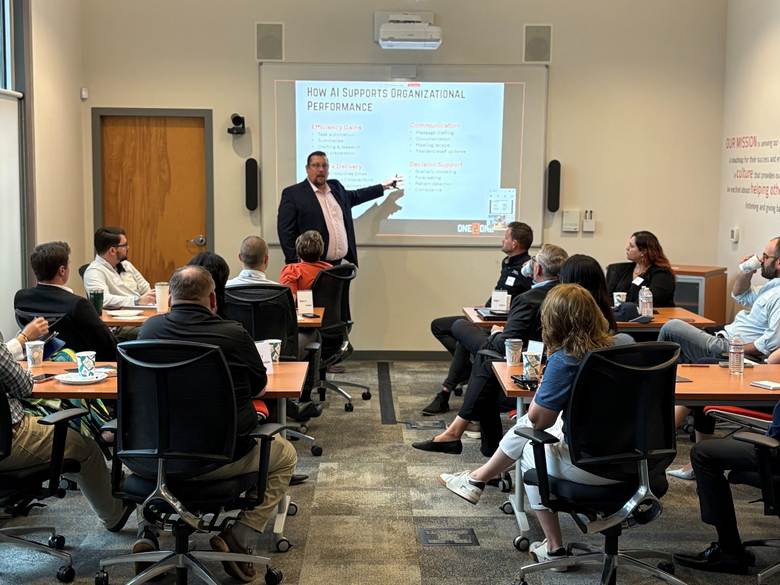
CEO of ONE 2 ONE Nicholas Paulukow presenting at July AI session.
These discussions give leaders an opportunity to share what they’re seeing inside their organizations, hear concerns and experiences from other executives, ask questions, and better understand the decisions businesses will face as technology continues to evolve.
The goal isn’t to create fear around emerging technology.
It’s to educate, empower, and help business leaders make confident decisions about how technology should be used in their organizations.
If you’re a business leader who wants to be part of the conversation, we’d love to have you join us at an upcoming discussion here at ONE 2 ONE.
More information here : Practical AI for Business Leaders – ONE 2 ONE
Because the businesses that benefit most from emerging technology won’t simply be the ones that adopt it first. They’ll be the ones that understand how to use it wisely.
Know what’s being used. Establish the rules. Educate your people. Monitor the risk. Make confident decisions. That’s the foundation for responsible AI adoption.

not secure