
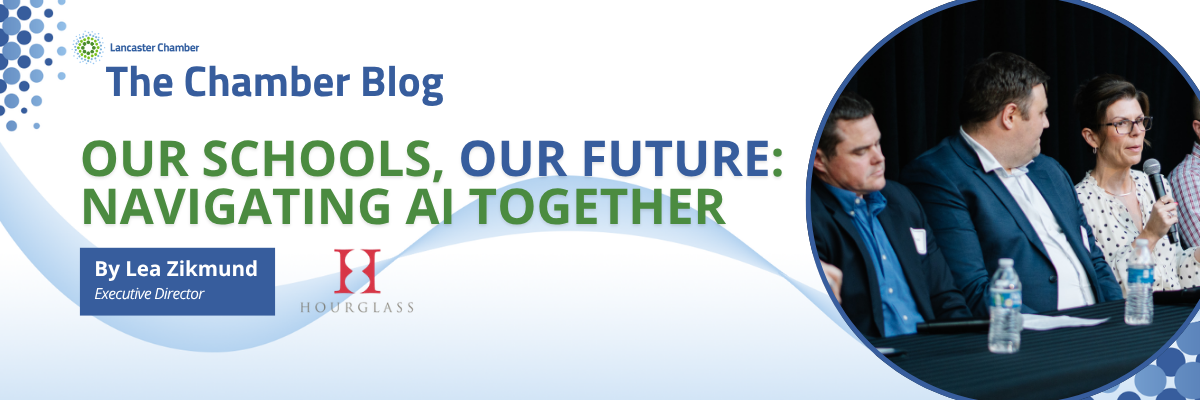
By Lea Zikmund, Executive Director of Hourglass
As artificial intelligence continues to reshape classrooms, workplaces, and daily life, one theme emerged clearly from Hourglass’ recent event, “Our Schools, Our Future: Navigating Artificial Intelligence Together”: the future of AI in education will depend less on the technology itself and more on the leadership guiding its use.
The conversation, hosted on Thursday, May 7th, brought together educators, administrators, and state leaders — including Dr. Carrie Rowe — to explore both the promise and challenges of AI in schools. But just as important as the topic itself was the setting. Hourglass has increasingly served as a convening space in Lancaster County for nonpartisan cross-sector dialogue, where civic leaders, educators, and community members can engage in complex issues shaping the region’s future.
Throughout the discussion, participants acknowledged that AI is already present in education. Students are using it to brainstorm ideas, organize thoughts, and support learning. Educators are experimenting with ways it can streamline planning and expand access to resources. At the same time, concerns remain around academic integrity, overreliance, misinformation, and the very legitimate concerns parents and teachers have about AI’s effect on mental health.
Strong leadership in this moment does not mean choosing between full adoption or rejection of AI. Instead, it requires building thoughtful frameworks that allow experimentation while maintaining accountability. It also requires ongoing dialogue as the technology continues to evolve.
For schools, that may look like investing in teacher training, developing clear guidance for student use, and creating space for conversations about ethics and digital literacy with students, teachers and parents.
Hourglass Lancaster’s role in hosting this conversation reflects a broader pattern in the community: creating spaces where leaders can work through complex, fast-moving challenges together rather than in isolation. That kind of convening power becomes especially important in moments of rapid change.
One of the most important takeaways from the forum was the recognition that no single institution has all the answers yet. Policies will continue to evolve, and so will the technology. But leadership grounded in transparency, adaptability, and curiosity may ultimately be the most important factor in determining outcomes.
As Lancaster County continues to navigate the rise of AI, the question may not simply be whether these tools belong in education. Instead, it may be: What kind of leadership is required to ensure they are used responsibly? How do we teach innovation alongside ethics? And how can spaces like Hourglass help communities learn these answers together?
Secretary Rowe captured the urgency of the moment, noting, “If education gets this moment right, AI won’t diminish humanity because educators have always done what matters most. They’ve helped young people become fully human in a changing world.”
About Hourglass
Lea Zikmund has been leading Hourglass as their Executive Director since November 2024. If you would like to receive invitations to their monthly events, sign up for membership and read more about our work on our website.

not secure