
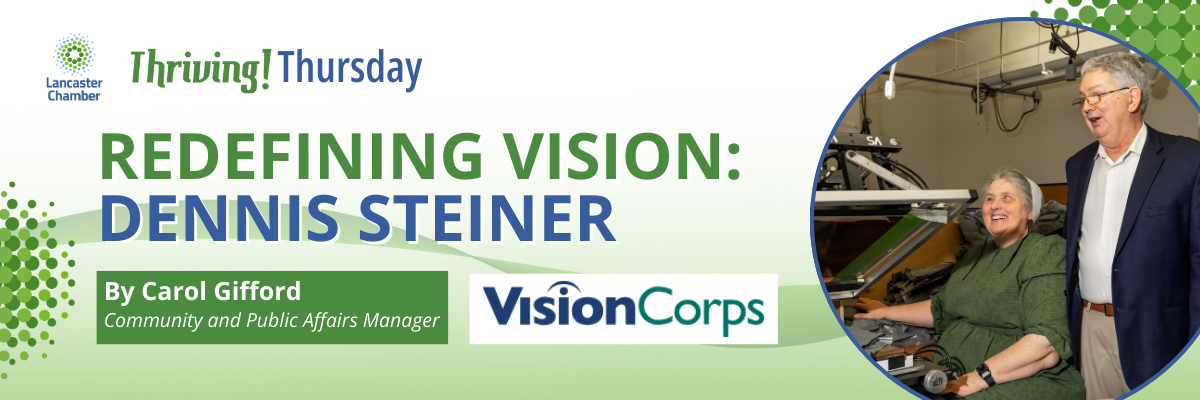
By Carol Gifford, Community and Public Affairs Manager at VisionCorps
A feature piece from our Fall 2025 issue of the Lancaster Thriving Publication
Employing the blind and visually impaired in the U.S. is a work in progress. Just ask Dennis Steiner. He leads a team of 195 employees in Central Pennsylvania and Little Rock, Arkansas, 102 of whom are blind or vision impaired. How does he accomplish this feat? Through innovation, technology and leadership.
As the President and CEO of VisionCorps, headquartered in downtown Lancaster, Steiner knows these challenges personally, as he has dealt with vision impairment since birth. He describes himself as a CEO who happens to be blind. After 42 years on the job – including 17 at the helm, he will retire this October. He is leaving the agency in strong financial shape, well-positioned to continue its mission of independence for the visually impaired through employment, rehabilitation services, and education. Steiner and his management team continuously implement workplace accommodations that support their employees’ growth in advancing VisionCorps’ mission: to empower individuals with low vision to achieve independence.
“We offer competitive employment and invest in our employees’ potential,” said Steiner, “but there’s more we want to do. I want people to understand that individuals who are blind can do almost anything that sighted people can.”
Steiner is nationally regarded as a role model for those with vision impairment in leadership positions. He has played a key role in the evolution of VisionCorps, leading major expansions and strategic initiatives. He oversaw the development of facilities in Lebanon, Philadelphia, and Somerset counties, and extended rehabilitation services into Chester County. In 2017, he facilitated a merger with ForSight Vision in York, and in 2024, expanded the agency’s manufacturing footprint to Little Rock, Arkansas. The organization also provides vision rehabilitation and blindness prevention services in five Pennsylvania counties: Adams, Chester, Lancaster, Lebanon, and York. It operates three employment centers (Lancaster, York and Little Rock, AR), all affiliates of the National Industries for the Blind (NIB), which helps procure federal contracts under the AbilityOne program and employs people who are blind and visually impaired, or have other disabilities.
NAVIGATING CHALLENGES
The visually impaired often have a hard time finding a job, as well as advancing once they do. In fact, the unemployment or underemployment rate for people with vision impairments is almost 70 percent.
Even just getting to work is another potential roadblock. People with vision impairments can’t drive, and until self-driving cars become widely available, reliable public transportation and timely paratransit remain scarce. Employees who live near their offices often walk to work. Steiner himself usually takes a bus to the agency’s North Queen Street office, located just across the street from the Red Rose Transit Authority’s main hub.
SUPPORTING THE MILITARY SINCE THE BEGINNING
VisionCorps will celebrate its 100th birthday in 2026. The original Lancaster County Association for the Blind was founded to support World War I soldiers returning home who had lost their sight during battle. The agency provided vision rehabilitation and taught valuable employment skills (which in the 1920s included chair caning). Over time, it expanded services to people of all ages and educational backgrounds.
The organization offers a variety of jobs for people who are blind, ranging from manufacturing lines to professional office jobs and more. People who visit the facility often have a similar reaction: “I didn’t know all that was going on here!”
At the Lancaster facility, employees manufacture a variety of helmet pads used by U.S. military. Annually, they make hundreds of thousands of helmet pad sets to protect military troops. in the Army and Navy. In addition, employees produce rifle slings and Navy neckerchiefs for troops. In York, employees produce reflective highway and mile marker posts for PennDOT and the Pennsylvania Turnpike Commission. They also work on packaging restroom deodorizers, purchased by large institutions and cleaning and preparing audiobook cartridges for the National Library Service program for the blind and print disabled.
In Little Rock, employees produce the Skilcraft® notebook line, widely used by the military and federal government offices. t is also home to VisionCorps’ rice packaging operation, where employees prepare and ship white, brown, jasmine, and basmati rice for U.S. troops stationed around the globe.
In addition, VisionCorps has a professional services group, 30+ remote employees with impaired vision who work on contract closeouts for the federal government. Think of people working on spreadsheets on computers – and doing it with special software programs that provide screen reader and screen magnification programs to help with the words, formulas, and cells.
On the job, people with impaired vision, explained Steiner, require some accommodations. For example, the VisionCorps helmet pad manufacturing line in Lancaster uses fixtures and jigs to help with the orientation of objects. Its rehab staff help with the set-up, layout and ergonomics of work stations. Technically, magnifiers help employees identify parts and audio cues on machinery notify them when a task is complete. This kind of modifications, minor and inexpensive, allow people with impaired vision to perform work like sighted individuals.
The NEXT CHAPTER
In his retirement, Steiner will continue his lifelong work advocating for people with impaired vision to live independently and pursue their goals and dreams. He has served in leadership capacities such as president of the National Association for the Employment of People Who Are Blind (NAEPB), and on the board of directors for the National Industries for the Blind (NIB), NAEPB, and VisionServe Alliance. In Pennsylvania, he served as chair of the board of directors of UniqueSource, formerly Pennsylvania Industries for the Blind and Handicapped, and treasurer for the Pennsylvania Association for the Blind and Core Career. Globally, he was selected as a U.S. delegate to the World Blind Union.
“People don’t understand the capabilities of those who are blind,” said Steiner. “I enjoy meeting with public officials and others to educate them about issues important to our community. Just give me five minutes with a legislator and I can explain what is important, why it’s needed, and how it makes sense.”
So, what’s next?
“Spending a little more time with my family, including my two grandchildren, Emma and Dale, and stays on our farm in Benton, PA.
“I also want to pursue my love of meteorology,” said Steiner. “Who knows? I might have a second career in weather forecasting.”

not secure