
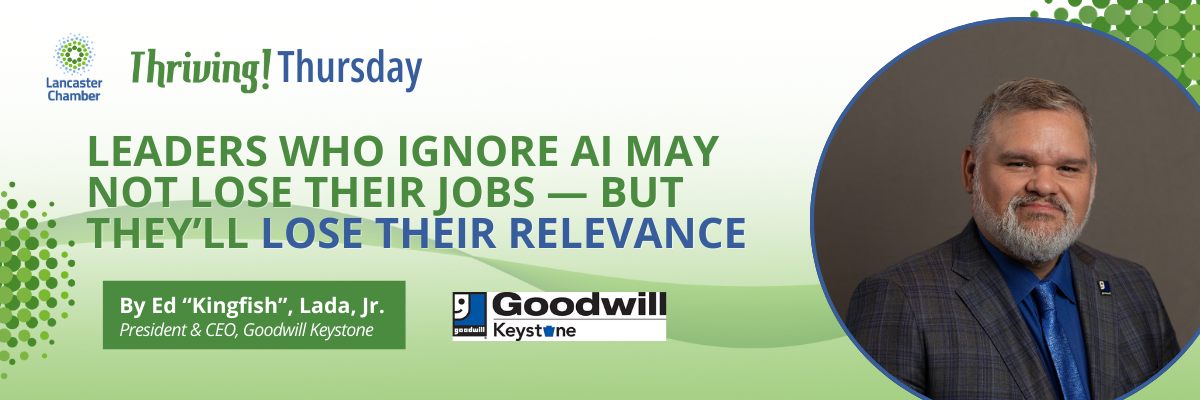
A feature piece from our Winter 2025 issue of the Lancaster Thriving Publication
By Ed “Kingfish”, Lada, Jr., President & CEO, Goodwill Keystone
Zach Kass, former OpenAI executive, painted a vivid picture of a utopian future at the Lancaster Chamber’s annual event — a world where artificial intelligence fuels scientific breakthroughs and gives back our most precious resource: time.
As much as I believe in AI’s potential to do radical good, I’m also skeptical that society will allow it to blossom free from the politics and consolidation of power that have defined every technological revolution. Kass’s message — that innovation should move fast, unregulated, with society left to self-police — follows Silicon Valley’s familiar playbook: let us cook so all can eat. It’s not entirely wrong. The geopolitical race for AI dominance is real, and America must compete. But buried in that optimism was a warning: you better pay attention.
Kass acknowledged the nearer term, darker outcomes — “idiocracy,” “dehumanization,” and what he called “identity displacement.” That last phrase struck me deeply. If AI fulfills its promise of abundance, what becomes of our identity as workers? At Goodwill Keystone, part of a federated model of non-profits making the largest workforce development provider in North America, our collective mission is rooted in the power of work — the belief that work provides purpose, independence, dignity, and stability. But what happens when work itself is no longer necessary? Humanity will need to redefine purpose in a world where survival and productivity are no longer the same thing.
Still, that’s tomorrow’s challenge. Today’s reality is that AI — especially large language models — has already transformed access to knowledge. The question every person should be asking is: How will this technology affect me, positively or negatively?
At Goodwill Keystone, we’re not waiting to find out. We’re the first Goodwill in the nation to teach AI Literacy as part of our workforce programs (January 2024). We’ve seen firsthand how AI helps people with barriers to employment — including those with disabilities and single parents facing what I call “time poverty.” For the mother juggling two jobs and kids, AI can act as a legal assistant, tutor, mechanic, or dietician — imperfect, yes, but accessible where once it wasn’t.
That accessibility is revolutionary. For the first time in history, expertise once reserved for the affluent and highly educated is available to anyone with digital access. But it forces a new question: if knowledge is democratized, what is the new value of expertise?
Kass opened with the “zombie apocalypse paradox” — our tendency to believe we’ll survive better than others. His warning: don’t assume you’re immune from disruption.
The message isn’t fear; it’s preparation. The leaders who understand how AI works — and how it fails — will shape its direction. My plea to every leader: lean in. Learn it. Use it wisely. Because this AI future won’t wait for the cautious — and neither will relevance in a world powered by AI.
Dive into an in-depth summary & analysis of the Keynote Speech from Zack Kass here!

not secure